

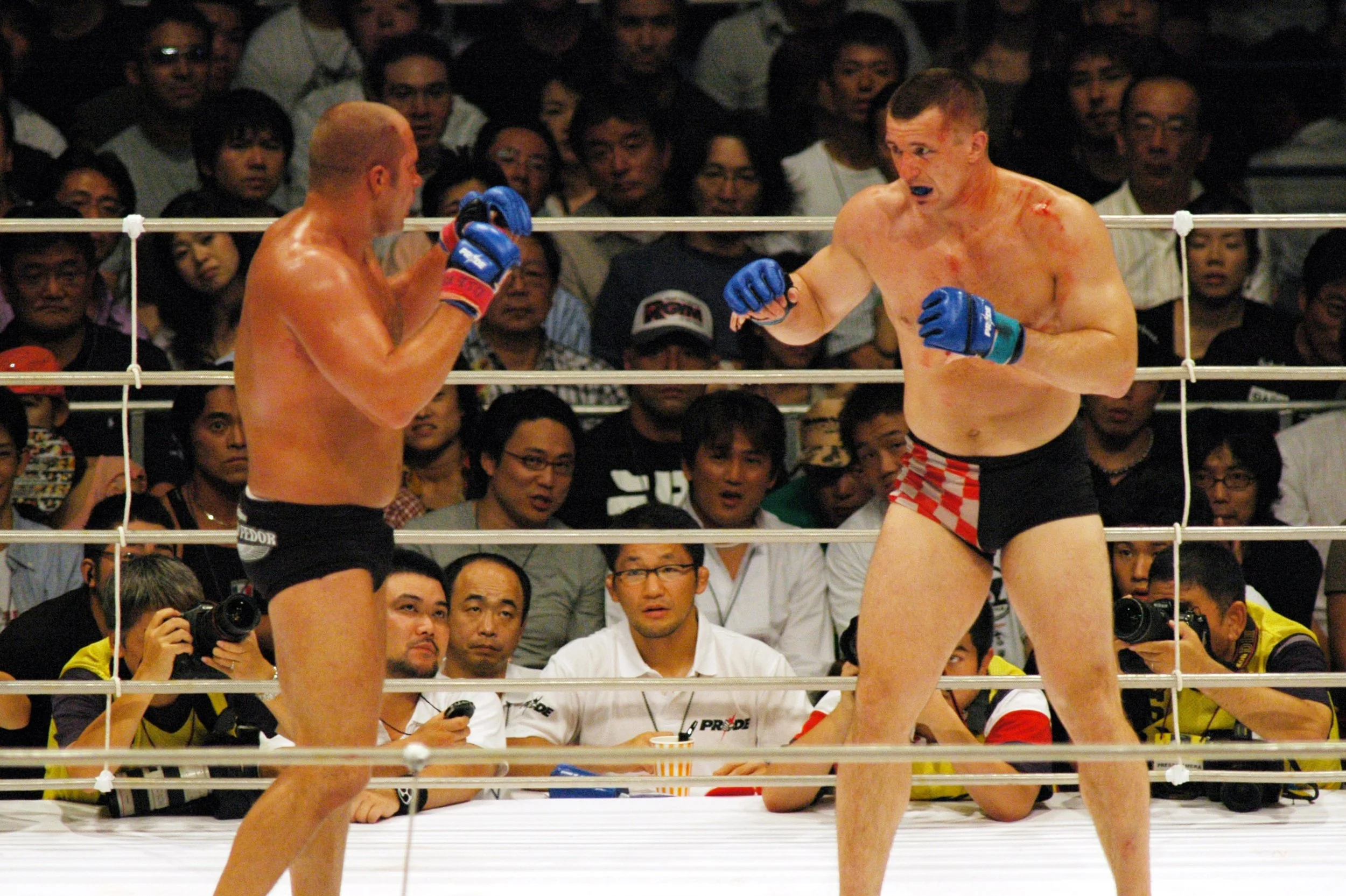
PRIDE Fighting Championships.
In the history of combat sports, there are promotions that host fights, and then there is PRIDE Fighting Championships.
For a decade, from 1997 to 2007, PRIDE wasn’t just the biggest mixed martial arts (MMA) organization in the world, it was a cultural phenomenon that blended the grit of real combat with the operatic scale of a Japanese rock concert. While the UFC was fighting for legitimacy in the United States, PRIDE was selling out 70,000-seat stadiums in Saitama and Tokyo, featuring the most terrifying human beings on the planet.
This is the story of how PRIDE rose to the top of the world, why it crashed so spectacularly, and why, nearly two decades later, fans still scream: “PRIDE Never Dies!”
I. The Genesis: From Pro-Wrestling to Blood Sport
PRIDE was born out of a uniquely Japanese desire to see “Who is the strongest?” On October 11, 1997, the first-ever PRIDE event was held at the Tokyo Dome. The main event featured Brazilian Jiu-Jitsu legend Rickson Gracie against Japanese pro-wrestling icon Nobuhiko Takada.
The goal was simple: Could a “fake” wrestler beat a “real” martial artist? (Spoilers: He couldn’t). But while Takada lost the fight, the spectacle won the hearts of Japan. The event drew 47,000 fans, proving that there was a massive appetite for a high-stakes, theatrical version of MMA.
The “Golden Age” (2000–2005)
Under the leadership of Dream Stage Entertainment (DSE), PRIDE evolved into the premier destination for global talent. While the UFC was still recovering from being banned on pay-per-view in the U.S., PRIDE was flourishing. They introduced the Grand Prix—monstrous, 16-man tournaments where fighters sometimes had to win two fights in a single night to be crowned champion.
II. Why PRIDE Was Different (and Better)
To understand why the “PRIDE Never Dies” slogan exists, you have to understand the specific elements that made it feel like a different sport entirely from the UFC.
1. The Spectacle and Production
Every PRIDE event began with a booming, orchestral theme song and the legendary “Screaming Lady” announcer, Lenne Hardt, who introduced fighters with a frantic, operatic energy. The entrances were cinematic: pyrotechnics, giant LED screens, and fighters descending from the rafters. It felt like the Super Bowl of violence every single month.
2. The Rules of Engagement
PRIDE rules were designed to favor aggression and “The Warrior Spirit”:
The Ring: Fights were held in a white boxing ring, which allowed for better visibility and prevented fighters from “stalling” against a fence.
The 10-Minute Round: The first round was ten minutes long. This tested a fighter’s cardio to the limit and made it nearly impossible to “win on points” by just holding someone down.
Soccer Kicks and Stomps: Unlike the UFC, PRIDE allowed kicks and knees to the head of a grounded opponent. It was brutal, but it ensured that the ground game remained dangerous and fast-paced.
Yellow Cards: If a fighter was being too defensive or stalling, the referee would issue a yellow card, which resulted in an automatic 10% deduction of the fighter’s purse. You were paid to fight, not to wait.
3. The “Freakshow” Fights
PRIDE wasn’t afraid to be weird. Alongside world-class athletes, they would book “Freakshow” matches, pairing 175-lb technicians against 400-lb giants like Giant Silva or Zuluzinho. While purists rolled their eyes, these fights brought in casual viewers and added a sense of “anything can happen” chaos.
III. The Legends: Faces of the Era
PRIDE was built on the backs of legendary figures who are still revered as the “Old Gods” of MMA:
Fedor Emelianenko: “The Last Emperor.” A stoic Russian heavyweight who went undefeated for nearly a decade in PRIDE, defeating everyone from Olympic wrestlers to K-1 kickboxers.
Wanderlei Silva: “The Axe Murderer.” The king of the 205-lb division, known for his terrifying staredowns and a style that consisted of walking forward and swinging hooks until someone fell down.
Kazushi Sakuraba: “The Gracie Hunter.” A pro-wrestler who used creative grappling to dismantle the legendary Gracie family, becoming a national hero in Japan.
Mirko Cro Cop: A Croatian anti-terrorist officer with a left high kick that became the stuff of nightmares. As he famously put it: “Right leg, hospital; left leg, cemetery.”
IV. The Fall: Yakuza and the Zuffa Buyout
As the saying goes, the flame that burns twice as bright burns half as long. In 2006, the foundation of PRIDE began to crumble.
The Scandal
A Japanese tabloid, Shukan Gendai, published a series of investigative reports alleging that PRIDE’s parent company, DSE, was heavily influenced by the Yakuza (Japanese organized crime). The allegations included money laundering and rigged matches.
While these rumors had circulated for years, the public nature of the report forced Fuji TV, PRIDE’s major television partner, to cancel their broadcasting contract immediately. Without TV revenue, the promotion was hemorrhaging money.
The Buyout
In 2007, in a move that shocked the MMA world, PRIDE was sold to Zuffa (the parent company of the UFC) for approximately $70 million. Fans hoped for a “UFC vs. PRIDE” super-promotion, but it was not to be. Zuffa quickly realized that PRIDE’s infrastructure was a mess, contracts were often verbal or nonexistent, and the brand was tainted in Japan.
PRIDE was shuttered, and its roster of legends was absorbed into the UFC. The final event, PRIDE 34: Kamikaze, took place on April 8, 2007.
V. Why PRIDE Never Dies
If the promotion has been dead since 2007, why does the slogan persist?
1. The “Bushido” Spirit PRIDE prioritized the way a fighter fought over their win-loss record. In the UFC, a “boring” win is still a win. In PRIDE, a boring winner was booed and fined, while a courageous loser was treated like a king. Fans miss that emphasis on the “Warrior Spirit.”
2. The Aesthetic From the iconic blue gloves to the white ring and the booming music, PRIDE had an identity that the “corporate” UFC lacks. It felt like a myth come to life.
3. The Legacy Almost every major star of the mid-2000s UFC era came from PRIDE. When Anderson Silva, Quinton “Rampage” Jackson, Mauricio “Shogun” Rua, and Dan Henderson dominated the UFC, they were carrying the PRIDE flag.
PRIDE Fighting Championships was a beautiful, chaotic, and ultimately unsustainable dream. It was the “Wild West” of MMA, a place where a Russian Sambo master could fight an American wrestler in front of 50,000 silent, respectful Japanese fans.
It fell because it was built on “sand and scandals,” but it lives on in every soccer kick highlight, every Lenne Hardt introduction, and every fan who remembers when the heavyweights were giants and the fights were legendary.
PRIDE Never Dies.
We write rarely, but only the best content.

